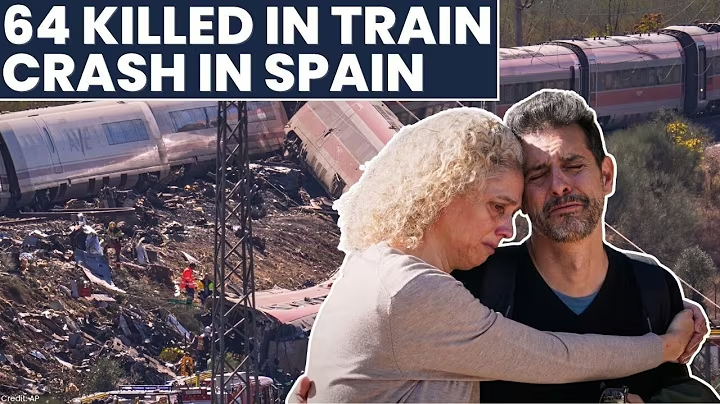
A devastating Spain train crash has killed at least 68 people after two high-speed passenger trains collided in central Spain on Wednesday, October 28, 2026. The accident left carriages badly damaged, passengers injured, and emergency crews searching through the wreckage for victims and survivors.
The collision occurred near Urda in Toledo province, south of Madrid, on a railway line connecting the Spanish capital with Seville and other destinations in southern Spain. Witnesses described a violent impact that threw passengers from their seats, scattered luggage throughout the carriages, and left injured people struggling to escape.
According to reports from the Associated Press, the regional government of Castilla-La Mancha confirmed at least 68 deaths. Another 58 people reportedly needed hospital treatment, although casualty figures may change as authorities continue their work.
The tragedy has shocked Spain and renewed concerns about railway safety as investigators try to determine exactly how the collision happened.
What Happened in the Spain High-Speed Train Crash?
The high-speed train crash in Spain involved a Renfe AVE train and an Iryo passenger train. Both were traveling from Madrid toward southern Spain when the collision occurred.
According to initial reports, the Iryo train had stopped on the tracks when the Renfe train struck its rear. The force of the impact derailed several carriages, sending damaged sections down an embankment and scattering debris around the accident site.
The collision occurred near the towns of Urda and Los Yébenes in Toledo province.
Hundreds of passengers were aboard the two trains. Emergency personnel rushed to the scene to evacuate survivors, treat the injured, and search the most severely damaged carriages.
The scale of the destruction made the rescue operation particularly difficult. Some passengers had to find alternative ways out of the damaged trains while emergency workers helped those who could not escape on their own.

Witnesses Describe the Terrifying Impact
Passengers who survived the collision described a sudden, violent impact that left people disoriented and frightened.
One passenger traveling on the Renfe train told Spanish broadcaster TVE that the train slowed abruptly before the collision. The impact sent luggage, cell phones, and other belongings flying through the carriage.
Other survivors described being thrown forward into seats or luggage as the carriages shook violently. Some passengers suffered injuries while trying to understand what had happened.
A witness quoted by Reuters described hearing a tremendous roar followed by a prolonged impact. From the train window, the passenger could see another wrecked train.
The accounts illustrate the confusion passengers experienced in the moments after the crash, when people were trying to find exits, help injured travelers, and reach safety.
Local Workers Rushed to Help Survivors
People working near the railway line were among the first to respond after hearing the collision.
David Gómez, a construction worker who was working nearby with his brother and another colleague, told Spanish newspaper El País that they heard the crash and ran toward the accident site.
When they arrived, they saw damaged carriages and passengers attempting to escape through windows. The workers crossed fencing to reach the area and used first-aid kits to help injured people before emergency services arrived.

Gómez described the scene as deeply distressing, recalling the difficulty of helping people trapped in the wreckage.
Their actions highlighted the role played by nearby residents and workers in the immediate aftermath of the disaster.
Firefighters, police officers, medical teams, and emergency personnel later joined the rescue operation in large numbers.
Death Toll and Injuries After the Collision
Authorities reported at least 68 deaths, while dozens of other passengers required hospital treatment.
The injured were transported to medical facilities across the region. Some passengers suffered serious injuries, while others were treated for cuts, bruises, and the effects of being thrown around inside the carriages.
Rescue teams concentrated on the most heavily damaged sections, where access was difficult and the risk of additional debris complicated their work.
Officials also began the process of identifying victims and notifying relatives.
Because the investigation and rescue operation were still developing, authorities continued working to establish the full number of casualties and understand the circumstances of the collision.

Which Trains Were Involved?
Two railway companies were involved in the accident.
Renfe is Spain’s state-owned railway operator, which runs passenger services throughout the country. Its AVE trains provide high-speed connections between major cities.
Iryo is a private high-speed rail operator that began operating in Spain in 2022.
Both trains were carrying passengers traveling from Madrid toward southern Spain. The Iryo train was reportedly stationary when the Renfe train struck it.
The collision caused major disruption to the railway network, particularly services connecting Madrid with Andalusia.
Passengers planning to travel through the affected area were advised to check official announcements for the latest information about cancellations and delays.
What Caused the Spain Train Crash?
The precise cause of the Spain railway accident remains under investigation.
Transport Minister Óscar Puente said preliminary information pointed to a problem involving the railway safety system and a subsequent decision by the central control center to allow the Renfe train to resume moving.

According to the minister’s account, a computer malfunction affected safety systems along a section of track, forcing trains to stop. The control center later authorized the Renfe train to continue while the Iryo train remained stationary.
Investigators are examining why the train was permitted to move, what instructions were communicated to the driver, and whether the signaling system was operating correctly.
Renfe said the train had been authorized to continue its journey before the collision. The company added that investigators would need to establish the sequence of events and the conditions at the time.
These are preliminary accounts, not a final determination of responsibility. The official investigation will need to establish the precise chain of events and identify any technical or operational failures.
Rail Services Suspended After the Disaster
Following the collision, services on the Madrid-Andalusia high-speed line were suspended.
The disruption affected passengers traveling between Madrid, Ciudad Real, and destinations in southern Spain. Railway authorities needed to keep the affected section clear while rescue teams worked and investigators examined the scene.
Hundreds of passengers faced travel changes, delays, and cancellations. Railway operators were expected to provide further updates as the situation developed.
Travelers should confirm their train status through official railway channels before leaving for the station.

Spain Mourns as Railway Safety Comes Under Scrutiny
The disaster has prompted an outpouring of sympathy for the victims and their families.
Prime Minister Pedro Sánchez canceled his scheduled activities to focus on the response. Spain’s King Felipe VI and Queen Letizia also expressed condolences to those who lost loved ones and support for the injured.
The crash has renewed questions about the reliability of railway signaling, infrastructure maintenance, and procedures for restarting trains after a safety-system failure.
Spain has developed an extensive high-speed rail network that connects major cities and serves millions of passengers. However, the latest collision follows another deadly railway accident in the country earlier in 2026.
Investigators will now face the difficult task of determining whether the crash resulted from an isolated failure or whether wider safety changes may be necessary.
For survivors and grieving families, the immediate priority is medical care, accurate information, and support as they begin to deal with the consequences of the tragedy.
1. How many people died in the Spain train crash?
At least 68 people were reported dead in the collision on October 28, 2026. The casualty figures should be checked against the latest official updates.
2. Where did the train crash happen in Spain?
The collision occurred near Urda in Toledo province, south of Madrid, on a railway line serving destinations in southern Spain.
3. Which trains collided in the accident?
The collision involved a Renfe AVE high-speed train and an Iryo passenger train.
4. What did witnesses say about the crash?
Survivors described a violent impact that threw passengers from their seats and sent luggage and personal belongings flying. Nearby workers also reported seeing passengers trying to escape through train windows.
5. What caused the deadly railway collision?
Investigators are examining a possible safety-system malfunction and the decision to allow one train to resume moving while another remained stopped. The final cause has not yet been established.