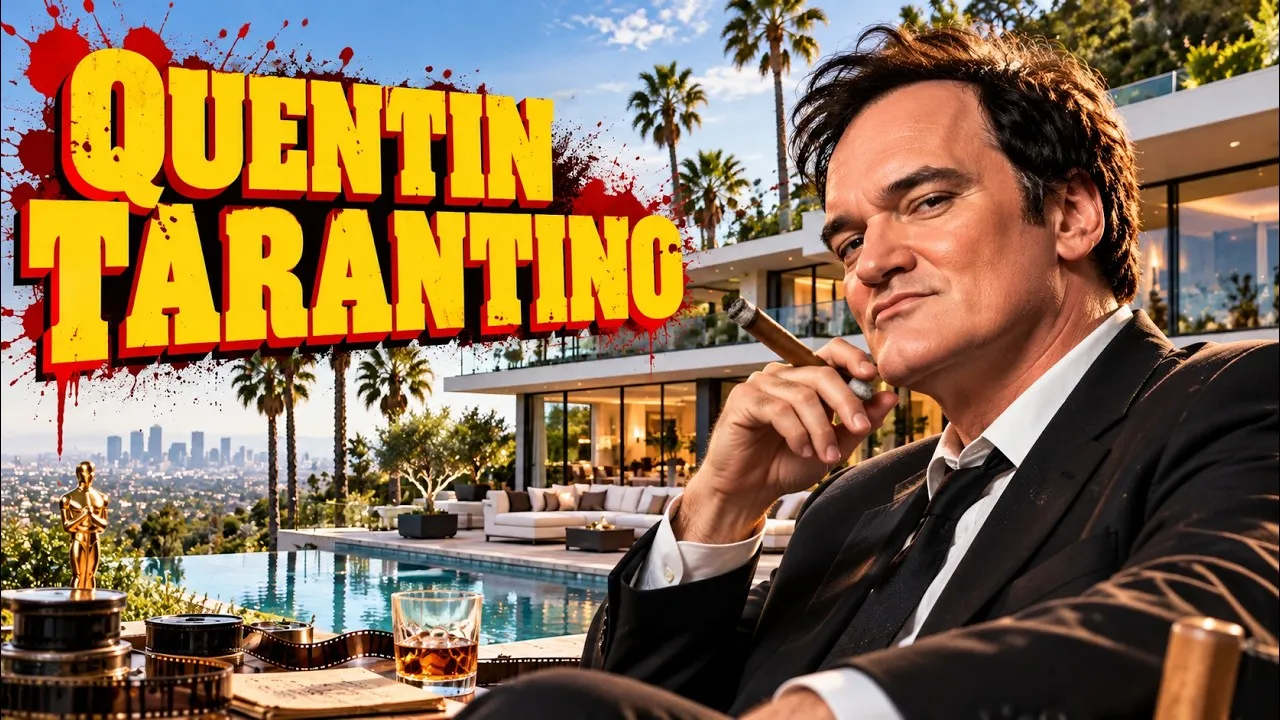
Quentin Tarantino has built a Hollywood career that most filmmakers can only dream of. His films have earned critical acclaim, attracted devoted audiences, and turned his distinctive storytelling style into a recognizable brand. With a reported net worth of around $150 million, the filmmaker is often viewed as one of the most financially successful directors of his generation.
But money and success in Hollywood do not always tell the whole story. Tarantino has long approached filmmaking on his own terms, prioritizing creative freedom, personal taste, and the kind of cinema he wants to see on the big screen. His career raises an interesting question: does accumulating a fortune necessarily mean a filmmaker has achieved everything he wants?
The reported $150 million figure offers a starting point for understanding his success, but it is important to distinguish estimates of his wealth from verified financial disclosures. Without a clearly identified, attributable statement detailing his latest remarks about his fortune, the precise nature of the supposed admission also needs to be treated carefully.
What is clear is that Tarantino’s career provides a fascinating look at how an independent-minded filmmaker can turn an unconventional creative vision into a valuable Hollywood career.
How Quentin Tarantino Built His $150 Million Fortune
Tarantino’s rise to Hollywood prominence began long before he became a household name. Born in Knoxville, Tennessee, in 1963, he developed a passion for movies at an early age. Rather than following the traditional route through film school, he spent time working at a video rental store in California, where he watched films, discussed cinema, and developed an unusually broad knowledge of movie history.
That experience helped shape the filmmaker audiences would eventually recognize. He became known for sharp dialogue, nonlinear storytelling, unexpected bursts of violence, memorable characters, and an ability to combine influences from different genres.
His breakthrough came with Reservoir Dogs in 1992. Made on a relatively modest budget, the crime film introduced audiences to his distinctive approach and established him as a director worth watching.
Two years later, Pulp Fiction transformed his career. The film became a cultural phenomenon, won the Palme d’Or at the Cannes Film Festival, and earned Tarantino and Roger Avary the Academy Award for Best Original Screenplay.
The commercial and critical success of these early films created opportunities that extended far beyond directing fees. A filmmaker with a recognizable style and a proven ability to attract audiences can negotiate more favorable contracts, develop valuable projects, and build a lasting professional reputation.

Tarantino’s reported wealth is generally understood to reflect decades of work across directing, writing, producing, and other film-related activities. However, the exact contribution of each source is not publicly established.
The Childhood Comment That Still Shapes His Relationship With Money
The admission attracting attention is not about an extravagant purchase or a financial setback. It concerns Tarantino’s relationship with his mother, Connie Zastoupil, and a promise he says he made to himself when he was just 12 years old.
According to an interview Tarantino gave on Brian Koppelman’s The Moment podcast in 2021, his mother became frustrated with his school performance because he was spending time writing screenplays instead of concentrating on his studies.
Tarantino recalled that she dismissed his writing ambitions with a sarcastic remark, suggesting that his “little writing career” was over. The comment struck a nerve because writing was already central to how he imagined his future.
He said he responded internally by deciding that, if he ever became a successful writer, his mother would not benefit financially from that success. He imagined a future in which he would not buy her a house, pay for vacations, or purchase the kind of luxury car he jokingly described as an Elvis Cadillac.
At the time, he was a child with an ambition and a promise. Decades later, after becoming an internationally celebrated filmmaker, he says that decision remained part of his approach to their relationship.
The story has resurfaced in October 2026 alongside renewed attention to his estimated $150 million fortune. The important distinction is that the underlying interview is from 2021; the admission itself is not a newly recorded conversation simply because it is circulating again.
Tarantino’s account also reveals how deeply he remembers the moment. His success did not erase the emotional effect of hearing someone close to him dismiss the very ambition that would eventually define his career.

Why Tarantino Says His Mother Will Not Receive His Fortune
Tarantino has said that he largely kept the promise he made as a boy. He did not buy his mother a house or a car, despite his considerable success in the film industry.
However, his account includes an important qualification. He said he helped her resolve a problem involving the Internal Revenue Service, commonly known as the IRS.
That detail matters because it makes the story more complicated than a simple claim that he has never helped his mother financially. His reported position is that he has refused to provide the major lifestyle benefits he once imagined withholding, while acknowledging that he did help her during a tax-related difficulty.
In the podcast conversation, Tarantino explained his reasoning by emphasizing that words can have lasting consequences when parents speak dismissively about something meaningful to their children.
His view is particularly striking because many people regard financial support for parents as one of the most natural ways to share the rewards of success. For Tarantino, however, the issue appears tied to a specific memory and his interpretation of what that moment meant.
There is also another side to the story. His mother publicly responded to similar coverage in 2021, telling USA Today that she supported her son, was proud of him, and loved him and his growing family. She also cautioned that podcast comments can circulate without their full context.
Her response provides a reminder that Tarantino’s recollection is one person’s account of a family disagreement. The wider relationship cannot be fully understood through a single interview, and the public has limited information about their private interactions.
Quentin Tarantino Net Worth 2026: What Is Known About His Wealth?
Tarantino’s fortune is commonly estimated at approximately $150 million, although he has not publicly provided a complete financial statement establishing that figure. Celebrity wealth websites and entertainment publications use estimates that may differ because their calculations rely on incomplete information.

His financial success is easier to understand when viewed through his long career in filmmaking. He has frequently taken on multiple roles, including screenwriter, director, and producer, giving him opportunities to earn from different aspects of a project.
The following table summarizes the main points behind the widely reported figure.
| Financial detail | What is publicly reported |
|---|---|
| Estimated net worth | Around $150 million |
| Primary profession | Film director and screenwriter |
| Other professional roles | Producer and actor |
| Breakthrough film | Reservoir Dogs (1992) |
| Career-defining success | Pulp Fiction (1994) |
| Major commercial hit | Django Unchained (2012) |
| Other notable films | Kill Bill, Inglourious Basterds, The Hateful Eight |
| Additional creative work | Books, screenplays, and film-related projects |
| Official personal balance sheet | Not publicly established |
| Financial admission making headlines | His reported decision not to buy his mother a house or car |
The $150 million figure should not be confused with the total amount his movies have earned at the box office. A film’s worldwide ticket sales are divided among exhibitors, distributors, studios, investors, and other participants. Production expenses, taxes, and contractual arrangements also affect what reaches an individual filmmaker.
For that reason, there is no reliable way to calculate Tarantino’s personal wealth simply by adding up the box-office totals of his movies.
His career nevertheless demonstrates how a successful filmmaker can build substantial wealth over several decades. A recognizable name, a strong track record, and the ability to write and direct commercially successful projects can create opportunities that extend well beyond a single paycheck.
The Films That Turned Tarantino Into a Hollywood Powerhouse
Tarantino’s financial success is closely connected to a filmography that has remained commercially relevant for decades. His movies are not simply one-time theatrical releases; they continue to attract new viewers through home entertainment, television, streaming availability, and renewed interest in cinema history.
Pulp Fiction established him as a major creative force, while later films expanded his reach. Kill Bill: Volume 1 and Kill Bill: Volume 2 delivered stylized martial arts action. Inglourious Basterds reimagined World War II history, and Django Unchained combined a Western setting with a revenge story that became one of his biggest commercial successes.
His 2019 film Once Upon a Time in Hollywood, starring Leonardo DiCaprio and Brad Pitt, earned widespread attention and brought Tarantino another Academy Award nomination for his screenplay.

| Film | Release year | Why it matters |
|---|---|---|
| Reservoir Dogs | 1992 | Established his distinctive filmmaking style |
| Pulp Fiction | 1994 | Delivered his international breakthrough |
| Jackie Brown | 1997 | Demonstrated his interest in character-driven crime stories |
| Kill Bill: Volume 1 | 2003 | Expanded his reputation for stylized action |
| Inglourious Basterds | 2009 | Combined historical fiction with suspense |
| Django Unchained | 2012 | Became one of his biggest box-office successes |
| The Hateful Eight | 2015 | Showcased his interest in contained, dialogue-heavy stories |
| Once Upon a Time in Hollywood | 2019 | Explored the changing culture of 1960s Hollywood |
Tarantino has also earned recognition for his screenwriting. He won the Academy Award for Best Original Screenplay for Pulp Fiction and later won the same award for Django Unchained. Those achievements strengthened his reputation as a filmmaker whose scripts have commercial as well as artistic value.
His business success is particularly notable because he has largely built his career around original stories rather than directing a long succession of established superhero or franchise properties. That approach has given his projects a distinctive identity, helping audiences recognize his work even when the genre and setting change.
Still, his precise earnings from individual movies remain difficult to establish. Public box-office numbers reveal a film’s commercial reach, not the amount its director personally keeps.
Tarantino’s Advice About Money Reveals Another Side of His Success
Beyond the family controversy, Tarantino has offered advice about protecting financial independence in an industry where success can disappear quickly.
In comments discussed by Fortune, he described delaying the purchase of a house until he felt financially comfortable enough to avoid becoming trapped by mortgage payments. He recalled that he did not buy his home until after Jackie Brown, even though the success of Pulp Fiction might have made an earlier purchase possible.
His reasoning was straightforward: large financial commitments can influence professional decisions. Someone who must continually meet expensive monthly payments may feel pressured to accept work that is not creatively satisfying simply because the income is necessary.
The lesson also connects with his reputation for wanting control over his career. Hollywood filmmakers frequently face pressure from studios, investors, and commercial expectations. Financial security can provide more room to choose projects based on personal interests rather than immediate financial needs.
Tarantino’s experience is not a universal blueprint for building wealth. Most people do not have access to the earning opportunities available to an acclaimed director, and homeownership decisions depend on income, housing costs, family needs, and local markets.

Nevertheless, the underlying point is widely applicable: earning more money does not automatically create financial freedom if spending commitments rise just as quickly.
His reported decision to delay buying a house also offers an interesting contrast with the promise he made about his mother. In both stories, he describes money as something connected to personal choices, independence, and consequences rather than merely a way to display success.
FAQ
1. What is Quentin Tarantino’s net worth in 2026?
Quentin Tarantino’s net worth is widely estimated at around $150 million. However, this is a published estimate rather than a verified figure based on a public financial statement.
2. Why did Quentin Tarantino say he would not give his mother money?
Tarantino said he made the decision when he was 12 after his mother criticized his writing ambitions. He later explained that he remembered the remark and vowed not to use his future success to buy her a house, fund vacations, or purchase a car.
3. Has Quentin Tarantino ever helped his mother financially?
According to Tarantino’s account, he helped his mother resolve a problem with the IRS. He also said he had not bought her a house or a car, despite his success.
4. Which Quentin Tarantino movie made him famous?
Pulp Fiction, released in 1994, was the film that established Tarantino as an internationally recognized filmmaker. It won the Palme d’Or at Cannes and earned him and Roger Avary the Academy Award for Best Original Screenplay.
5. How does Quentin Tarantino make his money?
His reported sources of income include screenwriting, directing, producing, acting, and other film-related work. His books and additional creative projects also contribute to his professional career, although the exact breakdown of his personal income has not been publicly established.