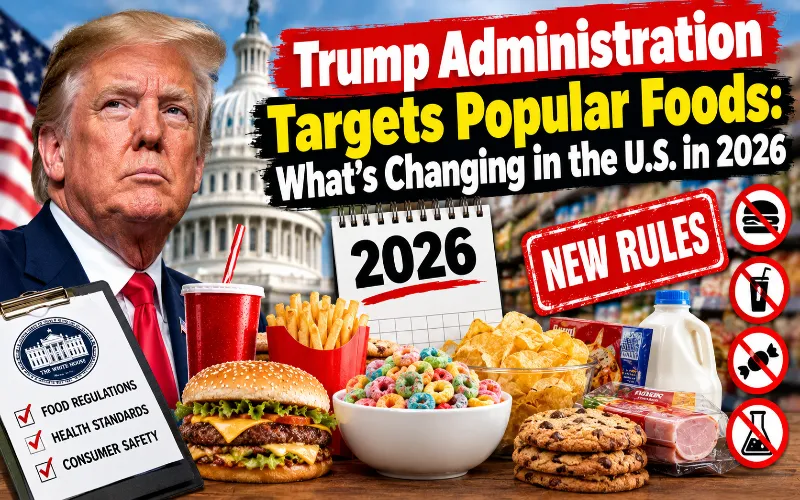

Food policy in the United States is evolving in 2026 as federal agencies introduce new regulations, review food ingredients, and update nutrition-related policies. These developments may affect food manufacturers, grocery retailers, restaurants, and families across the country.
Under President Donald Trump’s administration, the Department of Health and Human Services (HHS), led by Secretary Robert F. Kennedy Jr., has announced initiatives focused on food ingredient oversight and ultra-processed foods. The U.S. Food and Drug Administration (FDA) and the U.S. Department of Agriculture (USDA) are also implementing changes involving food safety, nutrition programs, and retail food requirements.
However, not every proposed policy is a final rule, and not every policy change means a popular food is banned. Understanding what has actually changed is essential for consumers who want reliable information about the American food supply.
What Is Changing in US Food Policy in 2026?
Several federal developments are attracting attention this year. They cover food ingredients, sodium reduction, ultra-processed foods, food safety, and the availability of staple foods through nutrition assistance programs.
The following table summarizes key developments and their potential impact.
| Policy area | What is changing? | Potential impact |
|---|---|---|
| Food ingredients | Proposed changes to oversight of certain food ingredients | Manufacturers may face additional notification requirements if the proposal is finalized |
| Ultra-processed foods | Federal work toward a proposed definition | Could help shape future nutrition research and policy |
| Salt substitutes | FDA issued a final rule in October 2026 | Manufacturers have more flexibility to reduce sodium in certain standardized foods |
| SNAP retailer standards | Updated staple food stocking requirements | Participating stores must offer a wider variety of staple foods |
| Food safety | Updated FDA guidance and safety initiatives | Businesses and regulators may adjust food safety practices |
These developments come from different regulatory processes, so their effective dates and legal status vary.
1. New Oversight of Food Ingredients
One of the major food policy developments in 2026 concerns how certain ingredients added to food are reviewed.
On August 10, 2026, HHS announced a proposed rule that would require manufacturers to notify the FDA when they conclude that a substance added to human or animal food qualifies as Generally Recognized as Safe, commonly known as GRAS.
GRAS is an important part of the US food regulatory framework. Under the existing system, certain substances may qualify for this status when the applicable legal and scientific criteria are met.
The proposed approach seeks to increase FDA visibility into these safety determinations.
What Does This Mean for Consumers?
Consumers may see more public discussion about food additives, ingredient safety, and how companies demonstrate that ingredients are safe for their intended uses.
However, the announcement should not be interpreted as an immediate ban on all food additives or as proof that every ingredient currently used in packaged foods is unsafe.
The proposed rule’s final requirements and implementation details should be checked against official FDA announcements.
2. Ultra-Processed Foods Receive More Attention
Ultra-processed foods are another major focus of the administration’s nutrition agenda.
These products often contain multiple processed ingredients and may include packaged snacks, sugary drinks, instant meals, and some ready-to-eat foods. However, processing levels vary widely, and the category does not automatically determine whether a particular product is nutritious or unhealthy.
In August 2026, HHS announced that a proposed federal definition of ultra-processed foods had been submitted for final review alongside the USDA.
Will Popular Packaged Foods Be Banned?
The announcement does not mean that all ultra-processed foods are banned in the United States.
A federal definition could help establish a more consistent framework for research, public health communication, and potential future policies. Any specific restrictions would require separate legal or regulatory action where applicable.
For shoppers, a practical approach is to compare nutrition labels, serving sizes, added sugars, sodium, fiber, and protein rather than relying only on a product’s marketing claims.
3. FDA Allows Salt Substitutes in Certain Standardized Foods
On October 9, 2026, the FDA issued a final rule permitting salt substitutes in foods covered by certain standards of identity that specify salt as a required or optional ingredient.
Previously, some of these standards limited manufacturers’ ability to use substitutes to lower sodium content.
The new rule provides manufacturers with additional flexibility to reformulate qualifying products.
Why Does Sodium Matter?
Sodium is an essential nutrient, but consuming too much can contribute to high blood pressure and increase cardiovascular health risks.
Food manufacturers may use the new flexibility to develop certain products with less sodium. The actual changes will depend on individual formulations and the requirements applicable to each food category.
Important: This rule does not mean that every salty food has been reformulated or that consumers must stop eating all products containing salt.
4. SNAP Retailers Face Updated Staple Food Requirements
The USDA has also updated stocking standards for retailers authorized to accept Supplemental Nutrition Assistance Program (SNAP) benefits.
Under the final rule announced in May 2026, participating retailers must meet updated requirements for the variety of staple foods they carry.
The framework covers four main categories:
- Protein foods
- Grains
- Dairy products
- Fruits and vegetables
The rule took effect on July 7, 2026, with retailers required to implement the provisions no later than November 4, 2026.
How Could This Affect Grocery Stores?
Retailers participating in SNAP may need to adjust their inventories to comply with the updated requirements.
The policy is intended to expand the availability of staple foods and establish clearer standards for stores participating in the program.
It is important to distinguish these retailer stocking rules from a nationwide prohibition on consumers purchasing specific foods with SNAP benefits. Separate federal or state policies may apply, so consumers should consult current official guidance for their location.
5. FDA Updates Food Safety Guidance
Food safety remains a central responsibility of the FDA and USDA.
The FDA released the 2026 edition of its Food Code, a model used by state, local, tribal, and territorial authorities when developing or updating rules for retail food establishments.
The Food Code provides guidance for settings such as restaurants, grocery stores, and institutional food services. It is a model code rather than an automatically binding nationwide rule; adoption and implementation depend on the relevant jurisdiction.
What Should Restaurants and Consumers Know?
Food businesses should monitor applicable local requirements, employee food-handling practices, sanitation procedures, and temperature controls.
Consumers should continue following basic food safety practices, including refrigerating perishable foods promptly, avoiding cross-contamination, and checking official recall notices.
The release of a new model Food Code does not mean that every restaurant in America must immediately change every procedure in the same way.
6. Will Food Prices or Grocery Shopping Habits Change?
Federal food policy changes can influence how manufacturers formulate products, how stores stock food, and how retailers meet regulatory requirements.
However, the effect on grocery prices will depend on several factors, including production costs, ingredient availability, supply chains, competition, and the specific policy involved.
For example, a manufacturer may choose to reformulate a product to reduce sodium, while a SNAP-authorized retailer may need to expand the range of qualifying staple foods it carries.
Neither development automatically establishes that grocery prices will rise or fall nationwide.
Consumers can make informed choices by comparing prices per unit, reading nutrition labels, and checking whether any advertised policy change is actually in effect.
7. What Should American Consumers Do in 2026?
As federal food policies evolve, consumers can take several practical steps to stay informed.
Read Nutrition Labels
Check serving sizes, added sugars, sodium, fiber, and other nutrients relevant to your dietary needs.
Verify Food Safety Alerts
Use official FDA and USDA recall notices to determine whether a particular brand, lot number, or product date is affected.
Distinguish Proposed Rules From Final Rules
A proposed rule may change before it becomes final. Look for official announcements that explain the legal status, implementation schedule, and any applicable exceptions.
Follow Official Government Updates
The FDA and USDA publish updates about food regulations, ingredient oversight, nutrition assistance, and food safety.
Avoid Misleading Headlines
Claims that a popular food has been banned should be checked against the actual government announcement. A review, proposal, or policy discussion is not necessarily a ban.
1. What are the major US food policy changes in 2026?
Major developments include proposed changes to GRAS ingredient oversight, federal work on defining ultra-processed foods, an FDA final rule allowing salt substitutes in certain standardized foods, updated SNAP retailer stocking standards, and the release of the 2026 FDA Food Code.
2. Is the Trump administration banning popular foods in 2026?
The developments discussed in this article do not establish a blanket nationwide ban on popular packaged foods. Individual products or ingredients may be subject to separate rules, recalls, or restrictions, so consumers should check the relevant official notice.
3. What is the FDA’s new rule about salt substitutes?
The FDA issued a final rule on October 9, 2026, permitting salt substitutes in certain standardized foods that previously restricted their use. This gives manufacturers more flexibility to reduce sodium in qualifying products.
4. What does the GRAS proposal mean?
GRAS stands for Generally Recognized as Safe. The August 2026 proposal seeks to require manufacturers to notify the FDA when they determine that an added substance qualifies for this status. Consumers should consult the official proposal for its current legal status and requirements.
5. What are ultra-processed foods?
Ultra-processed foods are generally understood as products made through extensive industrial processing, often using multiple ingredients. Definitions vary, and not every processed food has the same nutritional profile.
6. What changed for SNAP retailers in 2026?
The USDA finalized updated staple food stocking standards for participating retailers. The requirements cover protein, grains, dairy, and fruits and vegetables, with implementation required by November 4, 2026.
7. Where can I find official updates about US food regulations?
Consumers can check the FDA website at FDA.gov and the USDA website at USDA.gov for current announcements, final rules, proposed rules, and food safety alerts.

Read More