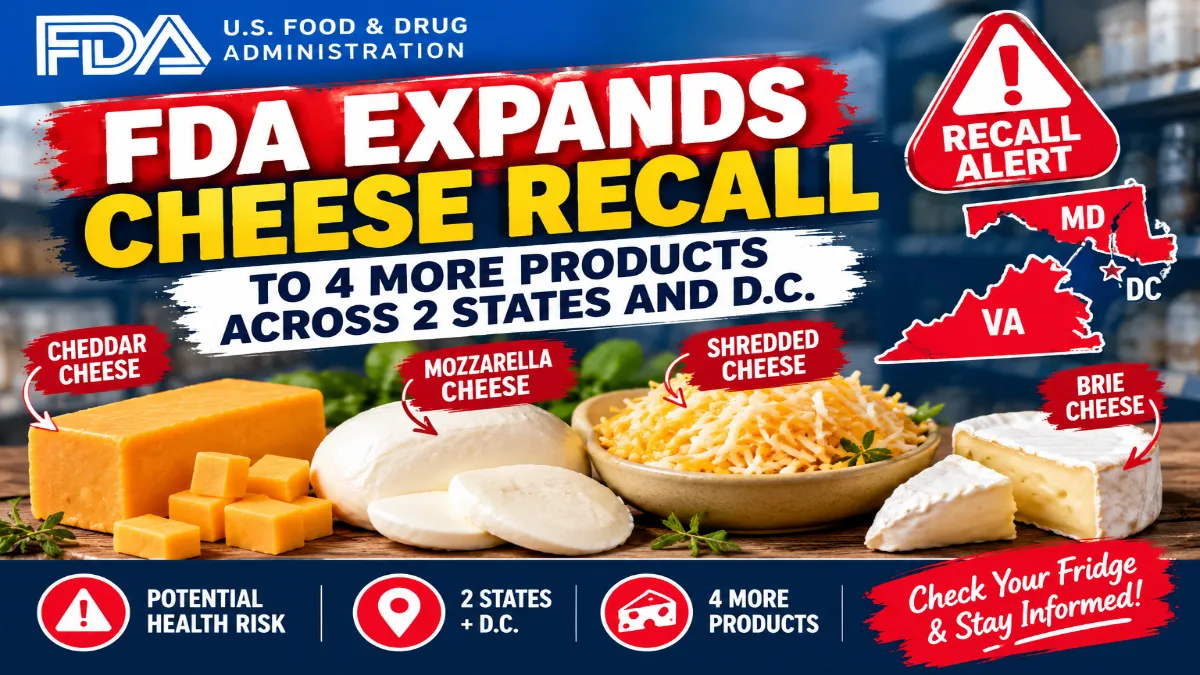

The U.S. Food and Drug Administration (FDA) has warned consumers about an expanded cheese recall involving products that may be contaminated with Listeria monocytogenes, a bacterium that can cause serious foodborne illness. The recall involves cheese manufactured by Clover Hill Dairy in Maryland, with products distributed across multiple states and Washington, D.C. Some products may also have been repackaged and sold under different brand names, making it important for shoppers to check product labels carefully.
The recall was expanded in June 2026 to include all cheese products manufactured by Clover Hill Dairy, rather than only its initially identified soft ricotta and requeson cheeses. Although the investigation has since been completed, consumers should still avoid any recalled products they may have stored at home.
Why Did the FDA Expand the Cheese Recall?
The recall was expanded because of concerns that additional cheese products manufactured at Clover Hill Dairy could be contaminated with Listeria monocytogenes.
The dairy, based in Mechanicsville, Maryland, initially recalled its soft ricotta and requeson cheese in early June 2026. On June 18, the company expanded the recall to cover all its cheese products because of the potential health risk.
According to the FDA, the recalled products included soft cheeses, cheddar varieties, Monterey Jack, Colby, cheese curds, flavored cheeses, and other products made at the facility.
The expanded recall was intended to protect consumers from potentially contaminated cheese, including products sold under different labels after being repackaged by distributors or retailers. Consumers should not assume a product is safe simply because its packaging does not prominently display the Clover Hill Dairy name.
Which Cheese Products Are Included in the Recall?
The expanded recall covers multiple varieties and package sizes of Clover Hill Dairy cheese.
Examples of affected products include:
- Ricotta and requeson cheese: Soft cheeses initially identified in the recall.
- Cuajada: Including soft cuajada, vacuum-sealed cuajada, and cuajada sold in brine.
- Cheddar cheese: Including white cheddar, sharp cheddar, and flavored varieties.
- Colby cheese: Including white Colby and Marble Jack.
- Monterey Jack: Cheese sold in several package sizes.
- Fresh cheddar curds: Products sold in smaller boxes.
- Flavored cheeses: Including Old Bay cheddar and horseradish cheese.
- Pepper cheeses: Including jalapeño cheddar, pepper jack, and varieties containing habanero peppers.
- Smoked cheeses: Including smoked cheddar and smoked pepper cheese.
The recall also covers certain assorted cheese snack packs and multipacks.
Package sizes vary, and some recalled cheese was sold in bulk containers before being repackaged for retail sale.
Consumers should consult the FDA’s official recall notice for the complete product list and packaging details.
Where Were the Recalled Cheese Products Sold?
According to the FDA and Maryland health officials, Clover Hill Dairy products were distributed through the company’s retail market, farmers markets, bulk distributors, and other retail channels.
The confirmed distribution areas included:
- Maryland
- New Jersey
- New York
- North Carolina
- Virginia
- Washington, D.C.
Some products may have reached additional locations through distribution networks. The affected products may also have been sold under other brand names, including KESSO, QUESOS LA RICURA, IZALCO, DE MI PUEBLO, and RIO LINDO.
Because products may have been repackaged, consumers should review manufacturer information and contact retailers if they are uncertain whether a cheese product is affected.
What Is Listeria and Why Is It Dangerous?
Listeria monocytogenes is a bacterium that can contaminate food and cause an infection called listeriosis.
Healthy people may experience relatively mild symptoms, but the infection can become severe in certain groups. Those at increased risk include pregnant people, newborns, adults aged 65 and older, and people with weakened immune systems.
Possible symptoms include:
- Fever and muscle aches
- Nausea or vomiting
- Diarrhea
- Headache
- Stiff neck
- Confusion or loss of balance in severe cases
Symptoms can begin within days or take several weeks to appear after exposure.
Pregnant people should take particular care because Listeria infection can lead to miscarriage, stillbirth, premature delivery, or serious illness in newborns.
Anyone who believes they have eaten contaminated cheese and develops concerning symptoms should contact a healthcare professional.
What Should Consumers Do If They Have Recalled Cheese?
Consumers who find a recalled product in their refrigerator should not eat it, serve it, or give it to others.
Follow these precautions:
- Check the product label. Look for the manufacturer name, product variety, package size, and any available plant identification information.
- Do not taste the cheese. Contaminated food may look, smell, and taste normal.
- Dispose of the recalled product safely or follow the manufacturer’s or retailer’s instructions for returning it.
- Clean surfaces and containers that may have come into contact with the cheese.
- Wash your hands thoroughly after handling the product or its packaging.
- Seek medical advice if symptoms develop, particularly if you are pregnant, older, or immunocompromised.
Some Clover Hill Dairy packages may identify the facility using plant or manufacturer permit number 24-128. However, repackaged products may carry different labels, so consumers should not rely on a single identification detail.
Has the Cheese Recall Investigation Ended?
The FDA’s updated outbreak investigation, published in August 2026, states that the investigation has been completed and the CDC declared the outbreak over.
The final investigation reported 15 illnesses, 14 hospitalizations, and one death associated with the multistate Listeria outbreak. The illnesses were reported across Illinois, Maryland, New York, and Virginia.
The FDA also noted that recalled products should no longer be available in stores or restaurants and that most were past their expiration dates.
However, the end of an investigation does not mean that recalled cheese kept in a household refrigerator is safe to eat. Consumers should continue to follow recall instructions for any affected products they find.
Final Thoughts
The expanded cheese recall highlights the importance of checking food safety announcements and reading product labels carefully. Clover Hill Dairy’s June 2026 recall eventually covered all cheese products manufactured at its Maryland facility because of possible Listeria contamination.
Consumers in Maryland, New Jersey, New York, North Carolina, Virginia, and Washington, D.C., should be especially aware of the distribution information, including the possibility that recalled cheese was repackaged under different brand names.
For the latest verified product details, review the FDA’s official cheese outbreak investigation and follow its safety guidance.
Staying informed, avoiding recalled products, and seeking medical advice when necessary can help protect you and your family from foodborne illness.

Read More