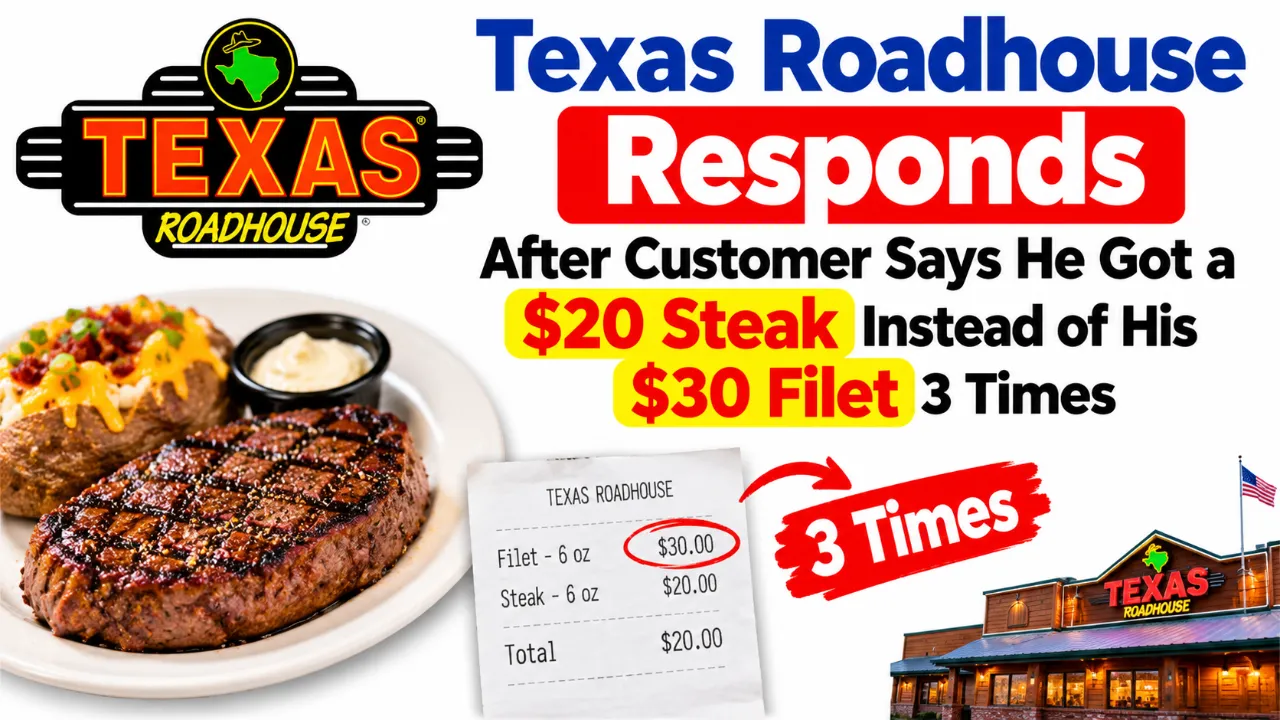

Texas Roadhouse Responds After Customer Says A Texas Roadhouse customer says he ordered a premium steak and repeatedly received a cheaper cut instead. His complaint has sparked an online debate about restaurant service, menu prices, and whether diners are always getting what they pay for.
Kenneth Card, a regular customer at the Texas Roadhouse location in Forsyth, Illinois, claims he was served an eight-ounce sirloin instead of the eight-ounce filet mignon he ordered on three separate visits. The price difference between the two steaks was more than $10, according to the restaurant’s listed menu prices.
Card shared his experience in a TikTok video posted on October 5, explaining why he believed the restaurant had repeatedly given him the wrong steak. The video attracted tens of thousands of views and prompted customers to share their own opinions about the situation.
Texas Roadhouse has since responded to the allegations. The company said it could not confirm that the same issue happened three times, although it acknowledged that a mix-up was corrected after Card raised the complaint. The distinction has become central to the story: the customer describes a repeated problem, while the restaurant says it could verify only one incident.
What Happened at the Texas Roadhouse Restaurant?
Card said he had been visiting the Forsyth restaurant regularly for about a year, often going roughly once a week. He also said his previous experience working in restaurant and hotel kitchens made him familiar with different cuts of steak.
According to Card, the first mix-up happened when he ordered filet mignon but believed the steak brought to his table was sirloin. He alerted the staff, who checked the order and replaced the steak with the filet he had requested.
He said he did not raise a complaint during the second incident, even though he again believed he had received the wrong cut. When the same situation allegedly happened on his third visit, he decided to speak with a manager.
Card said the restaurant took the steak away for another opinion. According to his account, staff confirmed that the steak was not the one he had ordered and arranged for him to receive the correct item.
The experience frustrated him because he believed the problem had happened repeatedly despite his continued visits to the restaurant. He later shared his account online, warning other customers to pay attention to what arrives at their tables.
Card’s account is the basis of the allegations, however, and it does not establish that the restaurant deliberately substituted cheaper meat. Texas Roadhouse has not confirmed the repeated incidents he described.
The $20 Steak Versus the $30 Filet: What Is the Price Difference?
The price difference is one reason the story has attracted attention. Menu prices listed for the Forsyth location showed an eight-ounce sirloin at $19.49 and an eight-ounce Dallas filet at $29.99.
That puts the difference at $10.50 before any applicable taxes or other charges. For a customer who specifically chooses a more expensive cut, receiving a different steak can feel like more than an ordinary ordering mistake.
| Menu item | Listed portion | Listed price |
|---|---|---|
| Eight-ounce sirloin | 8 oz. | $19.49 |
| Eight-ounce Dallas filet | 8 oz. | $29.99 |
| Price difference | Same portion size | $10.50 |
These figures are specific to the reported Forsyth location and may vary by restaurant or over time.
The two cuts also differ in texture. Filet mignon comes from the tenderloin, a muscle that generally produces especially tender meat. Sirloin comes from a different part of the animal and typically has a firmer bite and a more pronounced beef flavor.
Those differences can be noticeable to someone who regularly prepares or eats steak, although appearance alone does not always settle the question. Cooking method, thickness, seasoning, and doneness can affect how a steak looks and feels.
Card said his kitchen experience helped him recognize the cut he believed he had received. For customers who are less familiar with steak varieties, the difference may be harder to identify, which is one reason accurate ordering and clear communication matter in a restaurant.
How Did Texas Roadhouse Respond to the Customer’s Claims?
Texas Roadhouse acknowledged that Card raised a complaint and said the team corrected the issue. However, the company said it had not been able to verify that the problem occurred on three separate occasions.
A company spokesperson told news outlets that the restaurant had processes to double-check food quality and order accuracy before dishes leave the kitchen. The company also encouraged customers who receive the wrong item or believe they have been charged incorrectly to tell a team member while they are still at the restaurant.
That advice gives staff an opportunity to review the order, check with the kitchen, and correct a mistake before the customer leaves. It also creates a clearer record of what happened than a complaint made after the visit.
The company’s response does not confirm Card’s full account, but it does acknowledge that his complaint was addressed. That is an important distinction when discussing a viral story: a confirmed ordering mistake is not the same as proof that a restaurant repeatedly or intentionally substituted a less expensive item.
The incident also highlights how restaurants handle complaints when a customer believes the problem is not an isolated error. In such situations, an explanation from management can be just as important as replacing the meal. Customers generally want to know that their concern has been heard and that the restaurant has taken it seriously.
Why the Viral Video Sparked Mixed Reactions
The story prompted different responses online. Some commenters sympathized with Card, arguing that customers should receive the exact item they order, especially when there is a meaningful price difference. Others said they had experienced ordering mistakes at restaurants and understood why a repeated problem could damage trust.
Some social media users also questioned why Card continued returning to the same location if he believed the issue had happened before. Others defended Texas Roadhouse, pointing out that a mistake can happen in a busy kitchen and that the company said it corrected the confirmed incident.
These reactions reflect individual opinions rather than proof of a wider problem across the chain. The available reporting concerns Card’s experience at one restaurant in Forsyth, Illinois; it does not establish that other Texas Roadhouse locations have the same issue.
Card said he wanted to make other diners more aware of what they receive when ordering steak. He was surprised by the attention his post received, but his stated concern was straightforward: customers should get the food they paid for.
He also indicated that he did not expect to return to that particular Texas Roadhouse location and would try eating somewhere else. For a restaurant that depends on repeat customers, experiences like this can matter because trust is built through ordinary visits, not just advertising or menu prices.
What Should Customers Do If They Receive the Wrong Steak?
The Texas Roadhouse story offers a practical reminder for anyone dining out. Customers do not need to know every cut of meat to raise a concern if the food delivered to their table does not appear to match their order.
A few simple steps can help resolve the issue:
- Check the dish when it arrives, particularly if you ordered a specific cut or portion.
- Politely tell the server what seems incorrect before eating the meal.
- Ask the server or manager to verify the order with the kitchen if the difference is unclear.
- Review the receipt to make sure the item and price match what you ordered.
- If the problem is not resolved, ask management about the restaurant’s process for handling incorrect orders or charges.
These steps do not assume that a restaurant has acted deliberately. They simply give both the customer and the staff a chance to identify and correct a mistake.
In Card’s case, Texas Roadhouse says the complaint was made right, but the company has not verified the claim that the same issue occurred three times. Until more evidence establishes what happened during each visit, the repeated-substitution allegation remains disputed.
For diners, the larger lesson is simple: a restaurant order should match the item on the menu, and a customer should feel comfortable asking for clarification when it does not.
FAQs About the Texas Roadhouse Steak Complaint
1. Who complained about receiving the wrong steak at Texas Roadhouse?
Kenneth Card, a customer at the chain’s Forsyth, Illinois, location, said he received sirloin instead of the filet mignon he ordered on three separate visits.
2. How much did the two steaks cost?
The reported menu prices were $19.49 for an eight-ounce sirloin and $29.99 for an eight-ounce Dallas filet, a difference of $10.50.
3. What did Texas Roadhouse say about the allegation?
The company said it could not confirm that the problem happened three times, but acknowledged that Card’s complaint was addressed and the issue was corrected.
4. Why did Card believe he received the wrong cut of meat?
Card said he had experience working in restaurant and hotel kitchens and believed he could distinguish filet mignon from sirloin by their texture and other characteristics.
5. Is there evidence that Texas Roadhouse deliberately substituted cheaper steaks?
The available reporting does not establish deliberate substitution. The customer described repeated incidents, while the company said it could verify only one mix-up and that the complaint was corrected.

Read More