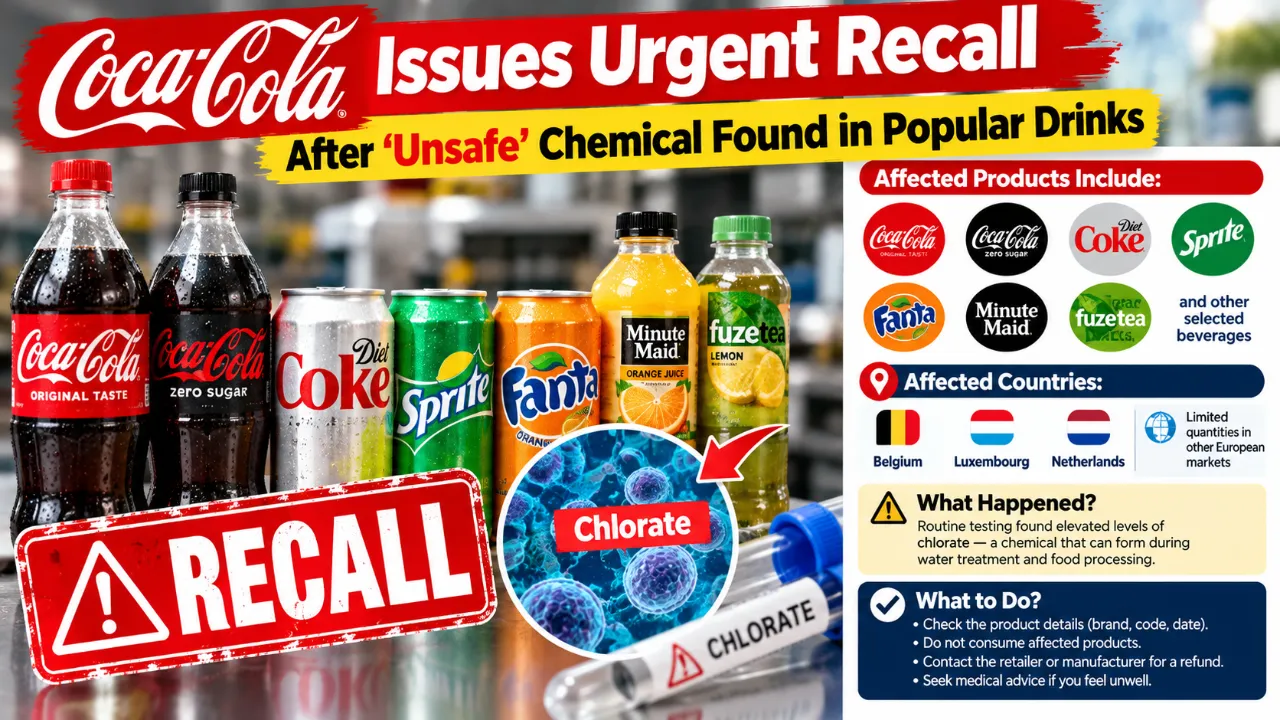

Coca-Cola Issues Urgent Recall : A Coca-Cola recall raised food-safety concerns in Europe after routine testing detected elevated levels of chlorate in certain soft drinks. The January 2025 recall affected specific products distributed primarily in Belgium, Luxembourg, and the Netherlands, with limited quantities also reaching some other European markets.
The discovery prompted Coca-Cola Europacific Partners (CCEP), the company’s European bottling partner, to withdraw affected products as a precaution. Although the company said the potential risk to consumers was considered low, the incident highlighted the importance of food-safety testing and checking product recall notices.
Why Did Coca-Cola Recall Certain Drinks?
The recall followed routine quality checks at a Coca-Cola production facility in Ghent, Belgium. Testing found that some drinks contained higher-than-expected levels of chlorate, a chemical that can form when chlorine-based disinfectants are used in water treatment and food processing.
Coca-Cola Europacific Partners said the affected products were being removed from sale as a precaution. The company also apologized to consumers and business partners for the incident.
Importantly, the recall applied to specific products and production batches—not every Coca-Cola drink worldwide.
Which Coca-Cola Products Were Affected?
Reports identified several beverage brands among the affected products, including certain batches of:
- Coca-Cola Original Taste
- Coca-Cola Zero Sugar
- Diet Coke
- Sprite and Sprite Zero
- Fanta
- Minute Maid
- Fuze Tea
- Other selected beverages, depending on the market
The exact products varied by country. Consumers were advised to check official recall notices for the specific product, package, and production code rather than assuming every drink under a listed brand was affected.
What Is Chlorate, and Why Is It a Concern?
Chlorate is a chemical compound that can remain as a residue when chlorine-based substances are used in water disinfection or food processing. Food-safety authorities regulate chlorate levels because excessive exposure may affect the body’s ability to absorb iodine.
Potential health concerns from high exposure include:
- Thyroid effects: Chlorate may interfere with iodine uptake, which is important for normal thyroid function.
- Greater sensitivity in children: Infants and young children may be more vulnerable to certain chemical exposures.
- Possible effects from high exposure: Large exposures can affect the blood’s ability to transport oxygen and may harm the kidneys.
The reported recall did not mean that everyone who consumed an affected drink would become ill. Coca-Cola’s bottling partner said independent expert analysis indicated that the likelihood of a related health risk was very low. <Cite refs={[“turn282188search0″,”turn282188search2”]}/>
Which Countries Were Included in the Recall?
The initial recall focused on Belgium, Luxembourg, and the Netherlands, where most affected products were distributed. Limited quantities were also reported in other European markets, leading authorities and distributors to review whether products had reached consumers.
In the United Kingdom, a separate precautionary recall covered a small number of imported cans and selected multipacks. Official notices listed particular products and codes, rather than all Coca-Cola packaging sold in the country. <Cite refs={[“turn282188news17″,”turn282188search21”]}/>
This was a Europe-related recall, not a blanket recall of Coca-Cola products across the United States. Consumers in the U.S. should consult current notices from the U.S. Food and Drug Administration (FDA) for information about any separate domestic recall.
What Should Consumers Do?
If you have a drink that may be covered by a recall, take these precautions:
- Check the product details: Compare the brand, package size, production code, and best-before date with the official recall notice.
- Do not consume a confirmed affected product: Follow the instructions provided by the manufacturer or local food-safety authority.
- Contact the retailer or manufacturer: Ask about a refund, return, or replacement.
- Seek medical advice if concerned: If you consumed a recalled product and feel unwell, contact a healthcare professional or local poison-information service.
Do not assume a drink is affected simply because it carries the Coca-Cola name. Recall coverage depends on the specific product and batch.
How Did Coca-Cola Respond?
Coca-Cola Europacific Partners said it began withdrawing affected products and cooperating with relevant authorities. The company also traced the issue to a specific container used in the water-treatment process at its Ghent facility.
The incident demonstrates why routine testing, traceability, and prompt communication are important in the beverage industry. These measures help companies identify potentially affected products and limit further distribution.
Is Coca-Cola Safe to Drink Now?
The 2025 incident concerned specific batches and markets. It should not be interpreted as evidence that all Coca-Cola products are unsafe.
Consumers should check official recall announcements for their own country and verify product details before making a decision. For U.S. consumers, the FDA is an appropriate source for current food and beverage recall information.
Final Thoughts
The Coca-Cola chlorate recall highlighted how routine testing can uncover potential food-safety issues before they become more widespread. While the reported risk from the affected drinks was considered low, consumers should always take official recall notices seriously.
The key takeaway: Check the exact product and production code, follow official safety instructions, and rely on verified updates rather than assuming every product from a major brand is affected.
Disclaimer: This article is for informational purposes only and is not a substitute for official recall notices or medical advice.
Frequently Asked Questions (FAQs)
1. Why did Coca-Cola recall certain drinks?
Certain drinks were recalled in Europe in January 2025 after routine testing found elevated levels of chlorate at a production facility in Ghent, Belgium.
2. Which Coca-Cola drinks were affected by the recall?
Depending on the country, affected products included specific batches of Coca-Cola, Coca-Cola Zero Sugar, Diet Coke, Sprite, Fanta, Minute Maid, and other beverages. Only the products and batches listed in the relevant recall notices were included.
3. Is chlorate dangerous to human health?
High levels of chlorate can interfere with iodine uptake and may affect thyroid function. The risk depends on the level and amount of exposure. The company said the likelihood of a health risk from the affected drinks was very low.
4. Was Coca-Cola recalled across the United States?
The widely reported January 2025 incident primarily concerned European markets. It was not a blanket recall of all Coca-Cola products in the United States. U.S. consumers should check current FDA recall notices for any separate domestic alerts.
SEO Title: Coca-Cola Recall: Chlorate Found in Certain Drinks
Focus Keyword: Coca-Cola recall
Meta Description: Learn why certain Coca-Cola drinks were recalled in Europe after elevated chlorate levels were detected, which products were affected, and what consumers should know.
URL Slug: coca-cola-recall-chlorate-chemical-drinks
Tags: Coca-Cola Recall, Coca-Cola News, Chlorate, Food Safety, Beverage Recall, Europe News, Consumer Safety

Read More