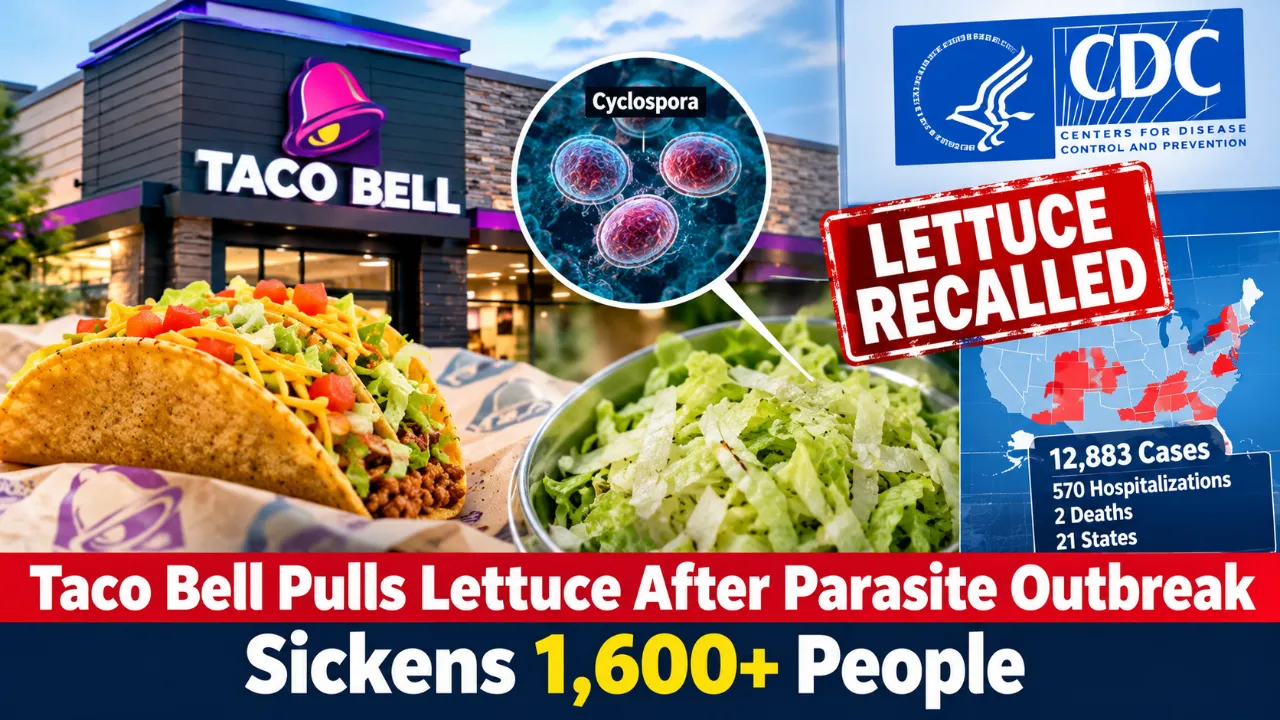

Taco Bell lettuce outbreak Taco Bell faced a major food safety investigation in the United States in 2026 after health officials linked a multistate parasite outbreak to shredded iceberg lettuce served at some of its restaurant locations. The initial investigation identified more than 1,600 confirmed infections among people who reported eating at Taco Bell, raising concerns about contaminated produce and restaurant food safety.
The outbreak later expanded as investigators identified additional cases associated with recalled iceberg lettuce. According to the Centers for Disease Control and Prevention (CDC), the final reported total reached 12,883 illnesses, 570 hospitalizations, and two deaths across 21 states. The CDC declared the outbreak over on September 11, 2026.
What Happened in the Taco Bell Lettuce Outbreak?
In July 2026, the CDC and the U.S. Food and Drug Administration (FDA) began investigating a multistate outbreak of cyclosporiasis, an intestinal illness caused by a microscopic parasite called Cyclospora cayetanensis.
Investigators identified shredded iceberg lettuce served at certain Taco Bell locations as a common exposure among people who became ill. The initial investigation involved customers in Indiana, Kentucky, Michigan, Ohio, and West Virginia.
On July 17, 2026, federal officials reported more than 1,644 confirmed infections among people who reported eating at Taco Bell in those five states. At that stage, at least 94 people had been hospitalized, and no deaths had been reported in that initial group.
How Many People Were Sickened?
The number of reported illnesses increased as health officials gathered additional information and identified cases associated with recalled iceberg lettuce.
By the final CDC update on September 11, 2026, the outbreak had reached the following totals:
- 12,883 reported illnesses
- 570 hospitalizations
- 2 reported deaths
- 21 affected states
These final figures cover the broader outbreak associated with contaminated iceberg lettuce, including people who reported exposure to Taco Bell or recalled lettuce from other sources. They should not be interpreted as cases caused exclusively by Taco Bell.
Which Ingredient Was Linked to the Outbreak?
The FDA’s traceback investigation identified shredded iceberg lettuce sourced from central Mexico as the ingredient linked to the outbreak. Investigators traced the lettuce to Taylor Farms de Mexico, a supplier connected to the affected food supply.
The evidence gathered by public health officials pointed to contaminated lettuce as the source of the infections. In July, Taylor Farms de Mexico announced that it would voluntarily remove iceberg lettuce sourced from central Mexico from the U.S. market.
Taco Bell also said it would stop using lettuce from the supplier identified in the investigation.
Why Was the Lettuce Dangerous?
The lettuce was associated with Cyclospora, a parasite that can contaminate food or water. People can become infected when they consume contaminated produce that has not been adequately washed or otherwise made safe.
Unlike many foodborne illnesses that develop quickly, symptoms of cyclosporiasis can take about a week to appear. The illness can also be difficult to identify without appropriate testing.
Common Symptoms of Cyclospora Infection
People infected with the parasite may experience:
- Frequent, watery diarrhea
- Stomach cramps or abdominal pain
- Bloating and increased gas
- Nausea and loss of appetite
- Fatigue and weight loss
- Occasionally, vomiting or fever
Symptoms may improve and then return. Some infections can persist for weeks without appropriate treatment, and dehydration can become a concern. Anyone experiencing persistent diarrhea after a suspected exposure should contact a healthcare professional.
What Did Taco Bell Do After the Investigation?
Following the initial findings, Taco Bell took steps to stop using the implicated supplier’s lettuce and remove potentially affected products from its restaurants. The supplier also initiated a voluntary removal of the implicated iceberg lettuce from the U.S. market.
Federal and state agencies continued investigating the source and distribution of the contaminated produce. Because the investigation expanded beyond the initial five states, the final case count was considerably higher than the number reported in the first announcement.
The CDC declared the specific outbreak over on September 11, 2026. The FDA continued investigating the contamination’s origin after the CDC’s final outbreak update.
Is Taco Bell Safe to Eat at Now?
The end of this specific outbreak does not mean that all lettuce or all Taco Bell food was contaminated. The investigation identified a particular supply-chain problem involving iceberg lettuce, rather than establishing that every restaurant location or menu item was unsafe.
The CDC reported that the contaminated lettuce associated with this outbreak was no longer available in stores or restaurants by the time the outbreak was declared over.
Consumers should continue following official food safety advisories, wash fresh produce appropriately, and seek medical advice if they develop persistent gastrointestinal symptoms after a possible exposure.
What Consumers Should Learn From the Outbreak
The Taco Bell lettuce incident highlights the importance of food safety throughout the supply chain. Even ingredients commonly considered healthy, such as fresh vegetables, can carry harmful pathogens if contamination occurs during production, processing, or handling.
Restaurants depend on suppliers to deliver safe ingredients, while public health agencies rely on case investigations, laboratory testing, and product tracing to identify the source of outbreaks.
For consumers, the key lesson is to stay informed about recalls and public health alerts rather than assuming that a food is safe simply because it is fresh or served at a familiar restaurant.
Final Thoughts
The 2026 Taco Bell lettuce outbreak began with more than 1,600 confirmed infections among people who reported eating at Taco Bell and eventually grew into a broader outbreak associated with contaminated iceberg lettuce. The final CDC figures recorded 12,883 illnesses, 570 hospitalizations, and two deaths across 21 states.
Although the CDC declared the outbreak over on September 11, 2026, the incident remains a reminder that careful ingredient sourcing, effective food handling, and timely public health investigations are essential to protecting consumers.

Read More