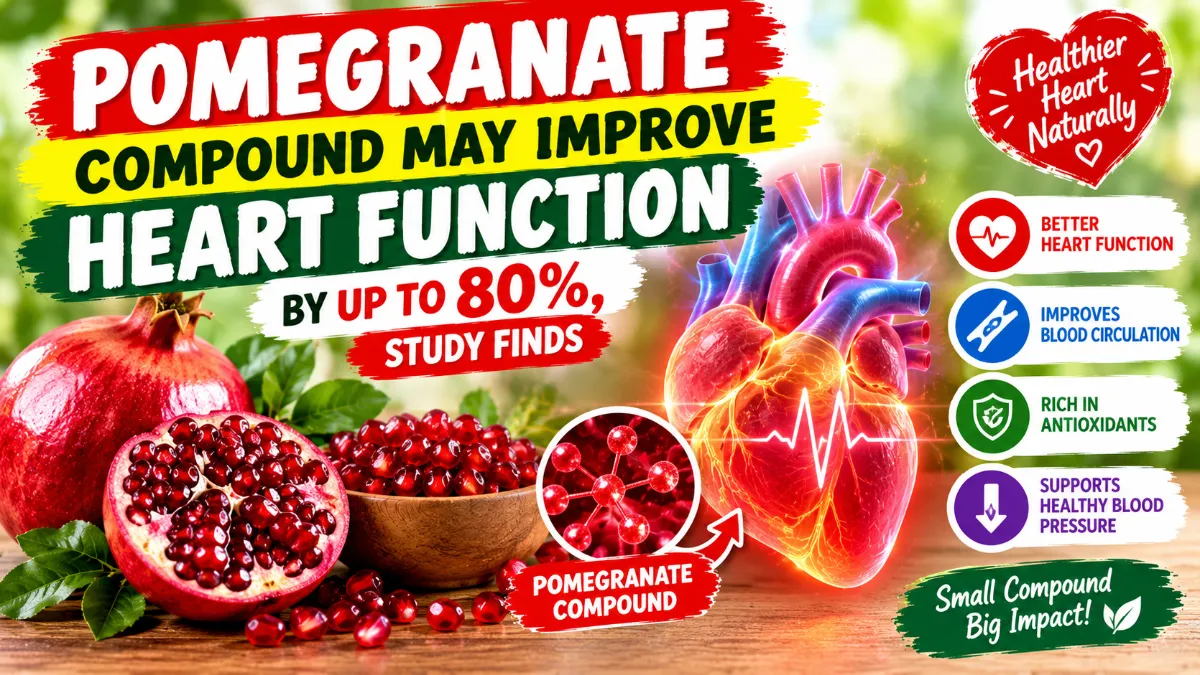

Pomegranates are widely known for their rich color, refreshing taste, and antioxidant content. Now, a new scientific study has brought this popular fruit into the spotlight for another reason: its potential connection to heart health.
Researchers at King’s College London have found that urolithin A, a compound the body can produce after consuming foods such as pomegranates, walnuts, and certain berries, improved measures of heart function by up to 80% in experimental models of a difficult-to-treat type of heart failure. The findings were published in Science Advances and could help scientists explore new approaches to cardiovascular treatment.
However, there is an important distinction: the results do not mean that eating pomegranates can improve a person’s heart function by 80%. The strongest findings came from animal research, with additional experiments performed on engineered human heart tissue. More clinical research is needed to determine whether the same benefits occur in people.
What Is Urolithin A?
Urolithin A is a natural compound produced when certain gut bacteria break down substances called ellagitannins, which are found in foods such as pomegranates, walnuts, and some berries.
Not everyone produces the same amount of urolithin A because gut bacteria and individual digestive processes vary. Scientists have studied this compound for its possible effects on cellular health and mitochondrial function, which helps cells generate energy.
In the latest research, scientists investigated whether urolithin A could also influence the way heart muscle works, particularly in a condition where the heart becomes stiff and struggles to relax between beats.
How the Pomegranate-Related Compound May Help the Heart
The researchers identified a protein called PKG1α, which plays a role in blood vessel function and heart muscle relaxation. Their findings suggest that urolithin A can activate a pathway involving this protein, potentially helping the heart relax more effectively.
In experimental models, the compound was associated with several encouraging changes:
- Improved heart function: Researchers reported improvements of up to 80% in certain measures compared with untreated models.
- Better heart muscle relaxation: The compound helped stiff heart tissue relax more effectively.
- Reduced fibrosis: It reduced harmful scar tissue that can interfere with normal heart function.
- Less abnormal enlargement: The compound limited enlargement of heart muscle cells in the experimental models.
These findings offer a potential direction for future research, but they are not proof that the compound treats heart disease in humans.
Which Type of Heart Failure Was Studied?
The research focused on heart failure with preserved ejection fraction, commonly known as HFpEF.
In this condition, the heart can continue pumping blood with a relatively normal ejection fraction, but its muscle becomes too stiff to relax and fill properly between beats. This can contribute to symptoms such as breathlessness, tiredness, and reduced exercise capacity.
HFpEF can be challenging to manage because several factors may contribute to it, including aging, high blood pressure, obesity, and diabetes. Researchers are therefore investigating new biological pathways that could eventually lead to additional treatment options.
The study does not establish urolithin A as an approved treatment for HFpEF. Instead, it identifies a possible mechanism that scientists can investigate further.
Key Findings From the Study
| Study detail | What researchers found |
|---|---|
| Compound investigated | Urolithin A |
| Foods associated with its production | Pomegranates, walnuts, and certain berries |
| Main condition studied | Heart failure with preserved ejection fraction (HFpEF) |
| Reported improvement | Up to 80% in certain measures of heart function in experimental models |
| Potential mechanism | Activation of the PKG1α protein pathway |
| Additional benefits observed | Better tissue relaxation and reduced harmful scarring |
| Human testing | Engineered human heart tissue was studied in the laboratory |
| Next research step | Clinical trials to test benefits in patients |
Important: The reported 80% figure refers to specific experimental measurements, not an 80% improvement in every aspect of heart health or a proven benefit from eating the fruit.
What Did the Human Heart Tissue Experiments Show?
To explore whether the findings might be relevant to people, the research team also tested urolithin A on engineered human heart tissue created using stem cells.
The laboratory tissue showed improved relaxation after exposure to the compound. This result supports further investigation because the heart’s ability to relax is central to the condition being studied.
Nevertheless, engineered heart tissue is not the same as testing a treatment in living people. Human clinical trials are needed to determine whether urolithin A improves symptoms, heart function, or quality of life in patients with HFpEF. Researchers must also establish appropriate doses, effectiveness, and safety for the intended use.
Can Eating Pomegranates Improve Heart Health?
Pomegranates can be part of a balanced, heart-conscious diet. They provide fiber when the seeds are eaten and contain plant compounds that researchers continue to study. Whole fruit is generally a useful way to add variety and nutrients to meals.
However, eating pomegranates is not equivalent to taking a studied dose of purified urolithin A. The amount of the compound produced by the body varies from person to person, and the study did not prove that eating the fruit directly produces the reported 80% improvement.
For a practical approach to heart health, consider these habits:
- Eat a variety of fruits and vegetables, including pomegranates if you enjoy them.
- Choose fiber-rich foods, such as whole grains, beans, vegetables, and whole fruit.
- Limit excess sodium, especially if a healthcare professional has advised you to do so.
- Stay physically active according to your abilities and medical guidance.
- Manage blood pressure, cholesterol, and blood sugar with appropriate lifestyle measures and medical care.
- Follow prescribed treatment if you have heart disease or heart failure.
No single fruit or food can replace a balanced diet, appropriate medical care, or prescribed medication.
Should You Take Urolithin A Supplements?
The findings may increase interest in urolithin A supplements, but the study does not establish these products as a treatment for heart failure.
Research into a compound’s biological effects does not automatically show that a commercially available supplement will produce the same results. Products can differ in formulation and dose, and evidence for one purpose may not apply to another.
Anyone living with heart failure or taking prescription medication should speak with a qualified healthcare professional before starting a new supplement. Do not stop, replace, or adjust prescribed heart medication because of this research.
What Happens Next?
The study offers scientists a potential new target for developing treatments for HFpEF, a condition with substantial medical challenges. The next step is to determine whether the promising experimental findings can be reproduced and translated into meaningful benefits for patients.
Future clinical studies will need to examine whether urolithin A can safely improve heart relaxation and other important outcomes in people. Until those results are available, the findings should be considered an early scientific development rather than a proven treatment.
Frequently Asked Questions (FAQs)
1. What is the pomegranate compound linked to heart function?
The compound is urolithin A. The body can produce it when certain gut bacteria break down plant compounds found in foods such as pomegranates, walnuts, and some berries.
2. Did the study find an 80% improvement in human heart function?
No. The reported improvement of up to 80% was observed in experimental models. Researchers also tested engineered human heart tissue in a laboratory, but the results have not established an equivalent benefit in patients.
3. Can eating pomegranates treat heart failure?
No. Pomegranates can be part of a balanced diet, but this research does not prove that eating them treats or reverses heart failure. Medical treatment should follow the advice of a qualified healthcare professional.
4. What is HFpEF?
HFpEF stands for heart failure with preserved ejection fraction. It occurs when the heart can pump with a relatively normal ejection fraction but becomes stiff and has difficulty relaxing and filling with blood.
5. Are urolithin A supplements proven to improve heart function?
The new study does not establish urolithin A supplements as a proven treatment for heart failure. More clinical research is needed to determine whether the compound is effective and appropriate for patients.
Final Thoughts
The discovery of a potential link between urolithin A and improved heart function is an encouraging development in cardiovascular research. By identifying a pathway involved in heart muscle relaxation, scientists may have opened a new direction for investigating HFpEF.
Still, the headline requires context: the 80% improvement was reported in experimental models, not demonstrated in people simply eating pomegranates. Until clinical trials establish the benefits, pomegranates are best enjoyed as part of a varied, balanced diet—not as a replacement for proven heart care.

Read More